Deadline: February 1, 2026
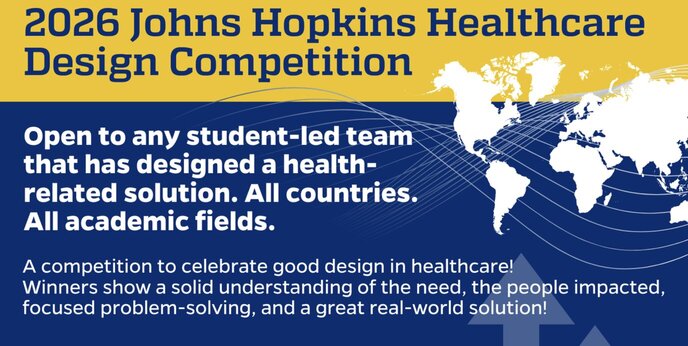
The Johns Hopkins Healthcare Design Competition 2026 invites student-led teams from around the world to develop innovative solutions that address real-world challenges in healthcare and public health. Organized by the Johns Hopkins Carey Business School and affiliated partners, this annual event calls on creative thinkers — including designers, engineers, entrepreneurs, clinicians, and researchers — to prototype ideas that can improve health systems, patient outcomes, care delivery, or access to essential services. The competition emphasizes human-centered design, feasibility, scalability, and social impact.
Benefits
Participating teams gain a variety of professional and academic benefits, including:
- Cash prizes, with the top award of $9,000 to support further development of the winning idea.
- Mentorship and coaching from healthcare professionals, design experts, and industry leaders.
- Exposure to real healthcare challenges and frameworks used by hospitals, clinics, and public health agencies.
- Networking opportunities with faculty, judges, sponsors, and other interdisciplinary student teams.
- A chance to improve critical thinking, design, and pitching skills in a competitive environment.
- Recognition on a global stage that enhances resumes and portfolios.
- Potential access to partner organisations interested in incubating or piloting promising solutions.
Eligibility Criteria
To be eligible for the Johns Hopkins Healthcare Design Competition 2026, student teams typically must:
- Consist of currently enrolled students at a university, college, or graduate school.
- Be led by two or more students (interdisciplinary teams are encouraged).
- Present a concept or prototype that addresses a specific need within healthcare design, delivery, policy, or patient experience.
- Demonstrate the relevance and potential impact of their solution.
- Be available to participate in required rounds of the competition, including presentations, semifinals, and the final showcase.
- Abide by competition rules regarding originality, intellectual property, and ethical design.
Application process and documents required
Design Brief:
The Design Brief is a two-page executive summary of your design project. The brief should be written for an audience of medtech engineers and designers who may not be as familiar as you are with your clinical and solution space.
Content
Design Briefs will be evaluated by following four criteria. We recommend the design brief is laid out in sections devoted to each criteria.
- Problem description (25%)
- Define the problem you are addressing, the clinical/healthcare background, and why there is a need for a better solution.
- Solution concept(s) (25%)
- Present your proposed solution with your design rationale and explain how it meets the needs of the stakeholders involved in your clinical/healthcare problem.
- Reduction to practice (25%)
- Describe the proof-of-concept experimental results you have completed and/or renderings and photos of your prototype(s).
- Pathway to implementation (25%)
- Describe the pathway that lies ahead for your project towards creating an impactful solution.
The Design Brief must be no more than 2 pages in length including figures. References can be listed as a separate page.
- Use an Arial, Helvetica, Palatino Linotype, or Georgia typeface, a black font color, and a font size of 11 points or larger. (A Symbol font may be used to insert Greek letters or special characters; the font size requirement still applies.)
- Type density, including characters and spaces, must be no more than 15 characters per inch. Type may be no more than six lines per inch. Use standard paper size (8 ½” x 11). Use at least one-half inch margins (top, bottom, left, and right) for all pages. No information should appear in the margins.
- Figures, plots, and/or photos are highly recommended but are counted towards the page limit.
- References can be included in a separate page and are not part of the two-page requirement
Questions? Please email cbid@jhu.edu, apolsan1@jhu.edu, or ksp@jhu.edu.
Deadline: Submit your application by 1st February 2026.
To Apply: Click here
Official Website: Click here